June 16, 2026
Hello, everyone.
This coming Tuesday, June 23, 2026, there will be a special council meeting. See the agenda here.
- First item: Renovation of the pedestrian mall has begun; the cost is 4 million NIS. Apparently, half is funded by the Ministry of Tourism and half by our local budget.
- Second item: A response to an inquiry I submitted revealed that the road construction on Achi Eilat Street is being funded by the council and not through resident fees, as is the case in other neighborhoods and streets.
- Third item: Zichron Ya’akov ranks low on the recently published 2025 Transparency Index for Local Authorities—there is such a lack of transparency on the website, and now it’s official since they reviewed and ranked all local authorities in the country.
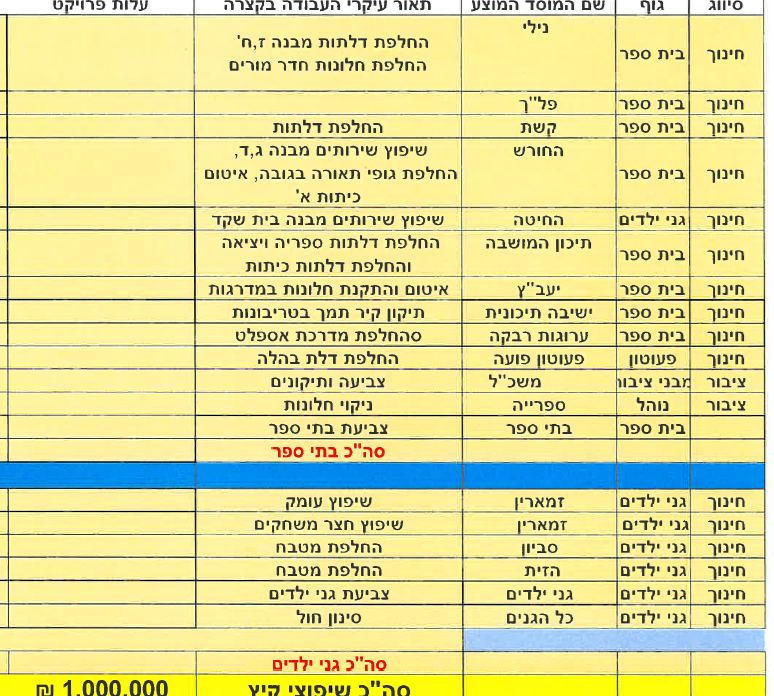
- Fourth issue: Summer renovations at educational institutions. At the upcoming meeting, the plenary will be asked to approve summer renovations at schools, kindergartens, and community centers at a total cost of 1 million NIS. See the table below for details on where and what will be repaired.
First item: Renovation of the pedestrian mall has begun, and the plenary session approved increasing the budget to 4 million NIS
At the last meeting, the City Council approved an increase in the special budget allocation by an additional 550,000 NIS, bringing the total cost of the pedestrian mall renovation to 4 million NIS. The funds are earmarked for upgrading the entire pedestrian mall—including outdoor furniture, playground equipment, benches, planters, and plants.
Part of the amount was received as a grant from the Ministry of Tourism. I do not know the exact amount. Based on figures provided by the council chairman, I estimate that the grant covers half the cost, with the other half coming from our budget. In my view, this is a worthwhile investment if it is accompanied by a massive investment in marketing and attracting tourists. A few months ago, a director of the council’s tourism department was appointed. Her office is located next to the historic site of the Binyamin Reservoir on the pedestrian mall. Let’s wish her success.
Second topic: A question I submitted regarding Achi Eilat Street revealed that the council does not collect a fee from the street’s residents, unlike in other neighborhoods where residents pay such fees.
This is the inquiry I submitted
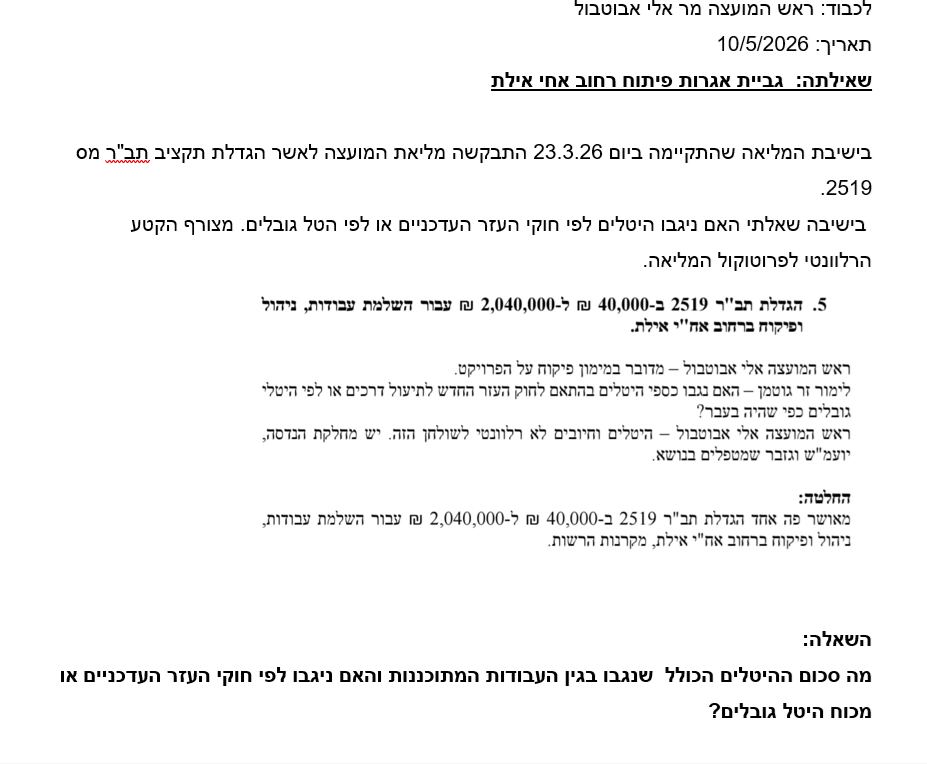
The response to the inquiry was brief: The council has not collected fees on Achi Eilat Street.
In other words, as of now, the council is funding a project that should be funded by a resident levy—just as they did for the Tizmoret and Neve HaMa’ayan neighborhoods. How are the residents of Achi Eilat Street any different?
Third issue: Zichron Ya’akov ranks at the bottom of the 2024 Local Authority Transparency Index—there is such a lack of transparency on the website, and now it’s official since all local authorities in the country were reviewed and ranked.
The Transparency Index for Local Authority Websites, summarizing data from 2025, was officially published on May 31, 2026, by the nonprofit “Transparency International Israel – Shvil,” in collaboration with the Israeli Internet Association and the organization “Penima.”
The criteria were divided into 18 key content categories, including:
- Contact Information and User Interface: Availability of contact methods with senior officials and department heads, presence on social media, accessibility menus, and mobile responsiveness.
- Authority Auditor and Freedom of Information: Publication of the auditor’s reports, minutes of the corrective action team, contact information for the Freedom of Information Officer, and publication of databases.
- Financial and Economic Information: Publication of the Authority’s budget (in an open Excel format), annual financial reports, planned versus actual data, salaries of the Authority’s five top executives, and property tax rates.
- Contracts, Tenders, and Human Resources: Transparency in infrastructure, procurement, and human resources tenders; publication of tender results and minutes of contracting committees.
- Planning, Construction, and Business Licensing: Presentation of engineering information, GIS systems (land use), planning committee decisions, agreements regarding building code violations, and conditions for obtaining business licenses.
- Social, Environmental, and Emergency Issues: Publication of environmental data (water quality, radiation, recycling), gender reports and wage gaps (Equal Pay Law), and the municipality’s emergency preparedness (information on shelters and resilience centers).
Seven municipalities received a perfect score of 100. Topping the 2025 Transparency Index were the cities of Ashdod, Yavne, Kfar Saba, Migdal HaEmek, Nahariya, Rishon LeZion, and Ra’anana—all with a perfect score and an A+ rating. They were followed by Tel Aviv, Or Yehuda, Dimona, Afula, and the Mevaseret Zion Local Council, with a score of 99. Also near the top of the rankings: Kiryat Motzkin, the Modiin Region, and Hod HaSharon with a score of 97, and Eilat with a score of 95.
The report painted a poor picture of transparency on our council’s website—a finding that will come as no surprise to anyone who has ever tried to find information there. The final score for 2025: 57%. As a result of this score, the council is classified as Level C—moderate/nearly good transparency (the group of local authorities with scores ranging from 55% to 69%).
On the positive side, the website showed an improvement compared to last year—in 2024, Zichron Ya’akov received a score of 30% and was classified as Level D. This represents a significant 27% increase.
But it’s still a very low score. And the goal should be an A. Look at the list of cities at the top of the rankings—there’s no reason we shouldn’t join them and thereby provide residents with full transparency on the website.
As I understand it, a new website is set to launch. I don’t know when, since people have been talking about it for two years now. But even on the existing website—here are a few suggestions that could improve transparency.
- Regularly update the information. For example, if a director changes, immediately publish the name and details of the new director. I checked, and the tourism director isn’t listed.
- Publish the budget in an open Excel format (rather than as a static PDF file), publish “planned vs. actual” data for budget line items, and publish salary data for the authority’s five top executives (by position).
- Publish periodic data on actual budget execution (not just the original budget approved at the beginning of the year).
- In many cases, the materials uploaded to the website focus only on general plenary sessions. To improve, the council should ensure the systematic uploading of additional minutes. For example, uploading minutes of the Executive Committee—as you may recall, I raised this issue and was told that there is no obligation to publish them. A vague response was given, stating that this is a committee mandated by law. This also applies to the following committees: the Procurement Committees, the Tender Committees, the Contracts Committee (the “Committee of Three”), and the minutes of budget discussions in the Finance Committee.
- Publication of information regarding the environment. This includes information collected by other entities (such as municipal associations or the Ministry of Environmental Protection). It is important to publish this information regularly on the council’s website: water quality data, noise and radiation measurements, the locations of telecommunocation masts, and current data and metrics on recycling rates and waste management in the municipality.
Fourth issue: Summer renovations at educational institutions, expected to cost 1 million NIS.
Every summer, educational institutions undergo renovations that mainly involve painting all the walls and other repairs that were not urgent enough to be carried out during the school year. Some of the renovations, such as painting, are usually performed by the school caretakers, while others are carried out by outside contractors. In the past, there was a tradition whereby the council hired teenagers from Zichron Ya’akov for summer work at educational institutions, thereby providing employment and wages to local residents.
See the table below for details on what is planned and where. All renovations listed in the table are scheduled to be completed by August 25, 2026. Please feel free to send me any questions on this topic: