June 26, 2026
Hello, everyone.
There are two topics in this week’s newsletter. At the top of each topic, you’ll find the title, which also serves as a summary.
Topic 1: Update on bylaw rates in accordance with Ministry of the Interior guidelines. These by-laws essentially form the basis for the fees the council can collect from us, the residents, when building a new home. These fees are earmarked for specific funds used exclusively to finance the construction of new infrastructure for public spaces, rainwater drainage, and the paving of roads and sidewalks.
The public open space levy is intended to fund neighborhood or district-level public open spaces. The levy is not intended to fund public open spaces in existing communities or to cover the ongoing maintenance or renovation of existing community public open spaces (POSS). The drainage levy is intended to finance the construction of infrastructure for the drainage of surface runoff (rainwater) (both above-ground and underground infrastructure) under the council’s jurisdiction, including all channels and facilities, with the exception of private channels.
The Road Construction Levy is intended to finance the construction of roads and sidewalks within the council’s jurisdiction, including expenses related to lighting, roadside landscaping, street furniture, etc.
Anyone wishing to learn more about exactly what the levy covers can read here: Zichron Ya’akov’s Bylaws for 2022. (Regulations published in the Official Gazette in 2022) These are the regulations in which the council was required to update the amounts. However, the rest of the provisions in the regulations remain unchanged.
Bylaws regarding the collection of fees do not result in a fixed annual charge for us residents. This is not like property tax or the security levy, which are collected every month. These are levies that will be collected only if and when, from the date of their approval, new homes are built or payments for levies have not yet been collected from homes that were already built.
These fees exist in most local authorities. Zichron Ya’akov was among the few authorities over the years that did not enact the relevant by-laws as required and as mandated by the Ministry of the Interior’s guidelines. This was only done during Ziv Desheh’s previous term, when the council plenary approved these by-laws as required and as included in the council’s efficiency plan.
It can also be said that because the by-laws were not enacted for many years prior to the previous term, the public coffers suffered due to the ineffective collection of the required levy rates (The old law established a boundary-based levy and applied only to the section where the property borders the street on which the house was built, rather than to the entire community or neighborhood).
How is the levy amount calculated for each area? The external firm performing the calculation reviews all approved and future plans for residential and industrial zones, and also factors in all roads, required drainage systems, and public spaces that will be needed. The basic assumption in a community such as Zichron Ya’akov is that residents make use of all the community’s spaces and infrastructure. From this, a base price per square meter of built-up area and per square meter of land is derived. Regarding the public space levy, there are several principles involved, such as defining a polygon for a residential area or the time period required to complete construction starting from the date of collection.
The table below, which I prepared, shows the changes in rates compared to what was set in 2022 and remained in effect through 2026 inclusive. I distributed this table to all council members and the council administration to seek clarification regarding a peculiar finding that emerges from it:
there is no uniform rate of increase.
There is no uniform rate of increase even within the same levy imposed on land compared to the same levy imposed on a house or apartment. The response was that the calculation was performed by an external firm that examines a number of parameters. The rates proposed by the firm had already been reviewed and approved by the Ministry of the Interior. All that remained was approval by the full council—which took place last Tuesday. Thus, these are the rates that will apply from the date they are published in the Official Gazette or from 2027 until the next update. Rates must be updated approximately every five years.
|
Type of Levy |
How much was the rate per square meter of land between 2022 and 2026? |
How much will it be per square meter of land starting in 2027 |
What was the rate per square meter of building between 2022 and 2026 |
How much will it be per square meter of building starting in 2027 |
|
Public Areas |
44.63 |
46.63 Increased by 4.48% |
75.51 |
100.49—Up 33.07% |
|
Drainage |
33.98 |
59.61—Up 74.53% |
57.49 |
129.01—up 124.43% |
|
Street Paving—Road |
52.76 |
68.28—up 29.38% |
89.26 |
147.76—up 65.46% |
|
Street Paving – Sidewalk |
35.18 |
29.26—down 16.84% |
59.51 |
63.33—up 6.42% |
|
Combined Street Paving |
87.94 |
97.54—up 10.92% |
148.77 |
211.9 – Up 42.37% |
Second Issue: Focusing on Real Estate Rather Than the Community. At first glance, the summer program distributed by the council looks very impressive. However, a closer reading of the program reveals that many community and tourism events that took place in the past will not be held this year. And what is mentioned consists of existing events that were included in the announcement to pad the volume, such as theater performances as part of the annual subscription program, regular lectures, specialized summer camps, and more.
See below the advertisement for July and August and the events at Moshava Park. The flyer appears “packed with content,” but it includes summer camps, theater performances from the annual subscription program that just happen to take place during the summer months, lectures as part of Jewish culture programs, and activities from the Hatzav Club —these are regular, welcome fixtures of daily life that do not constitute specially prepared summer activities. What does constitute a special summer activity? Performances in the park. So why is there only one show for children and two for adults?
- There’s no La Strada Festival every Thursday on the pedestrian mall. This festival, which had become a tradition, attracted large crowds of locals and tourists—with free admission for residents—and served as an economic driver for business owners. I’m not sure if this is due to budget issues at the community center or renovations on the pedestrian mall, but for the sake of residents and tourism, they should have kept this festival going—or, for example, organized a suitable alternative at Gan Tiul or any other public space.
- Few events in neighborhoods/parks. There are almost no community center events in the neighborhoods.
- Storytime events in neighborhood parks were not listed. (Perhaps they will be published later?)
- There are almost no free events; every activity costs money.
To visually illustrate my point, I’ve highlighted in a red box the activities that are part of the regular year-round program.
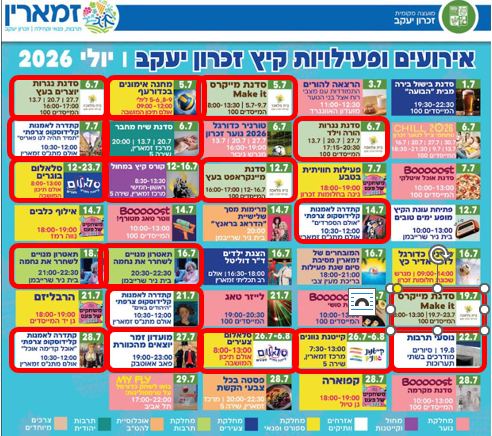
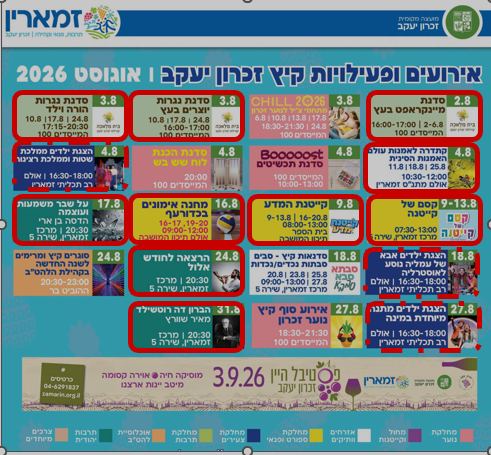
Only two performances in Moshava Park, compared to five in the past